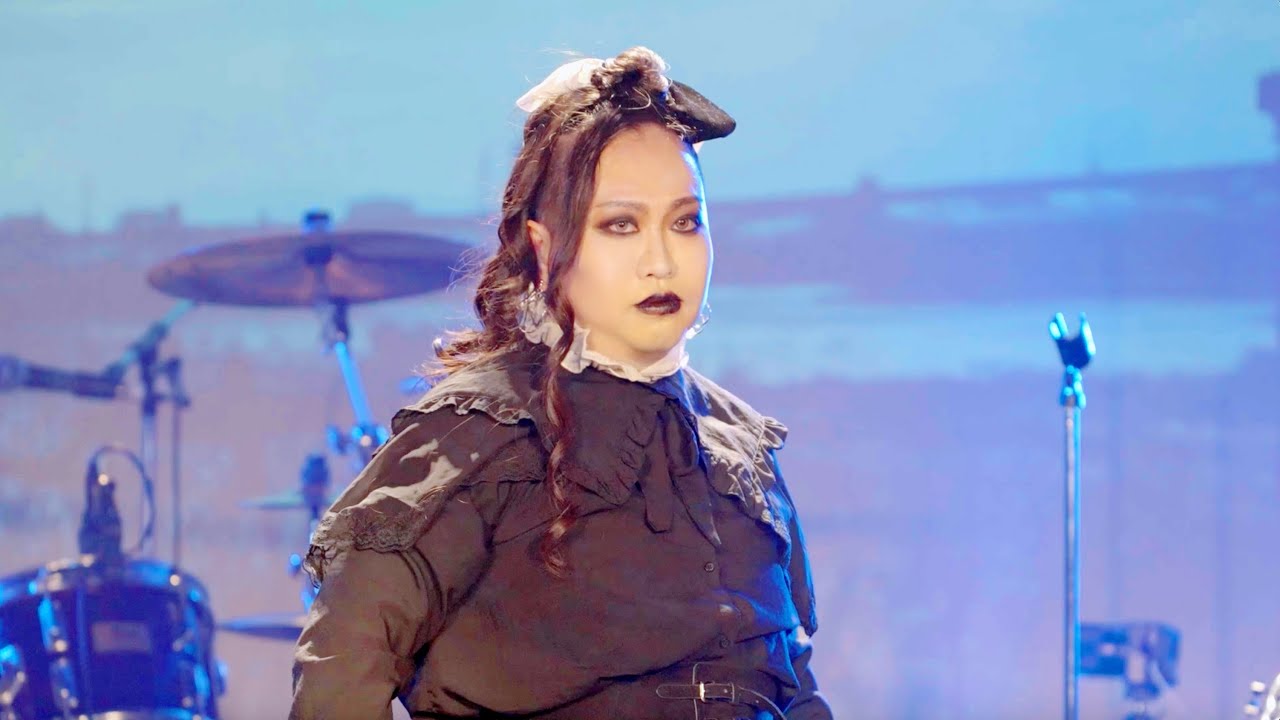
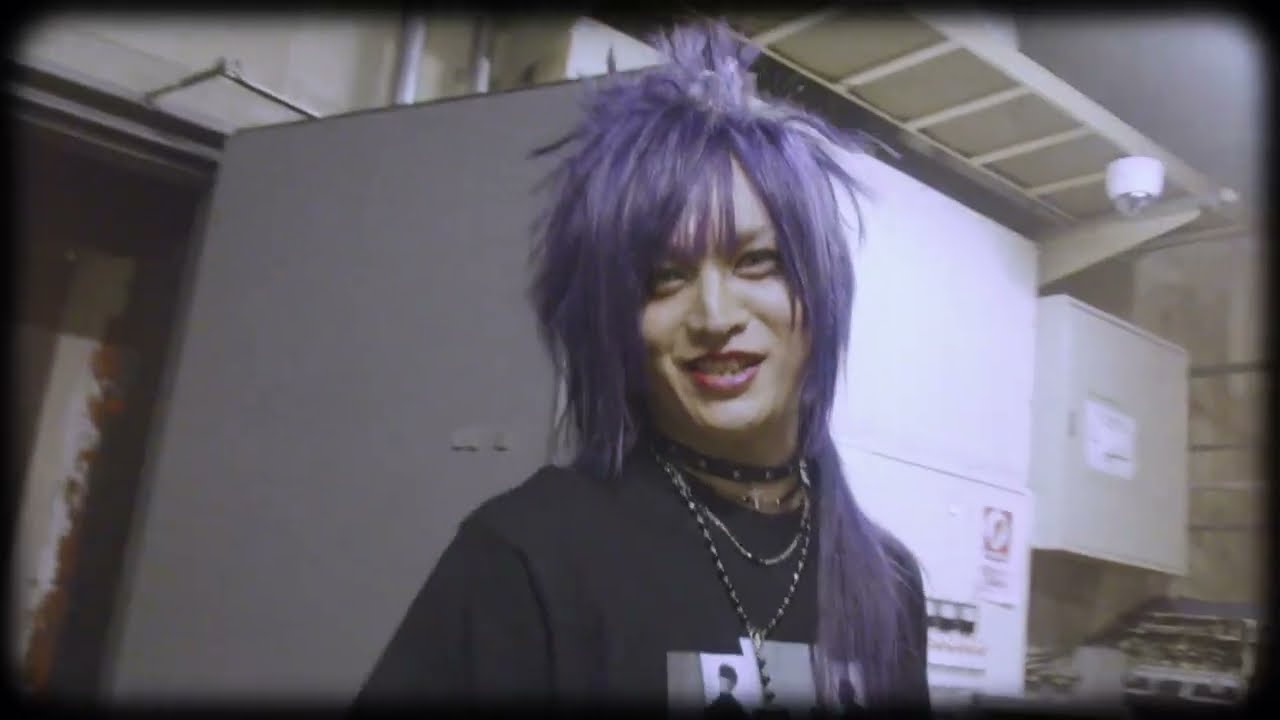
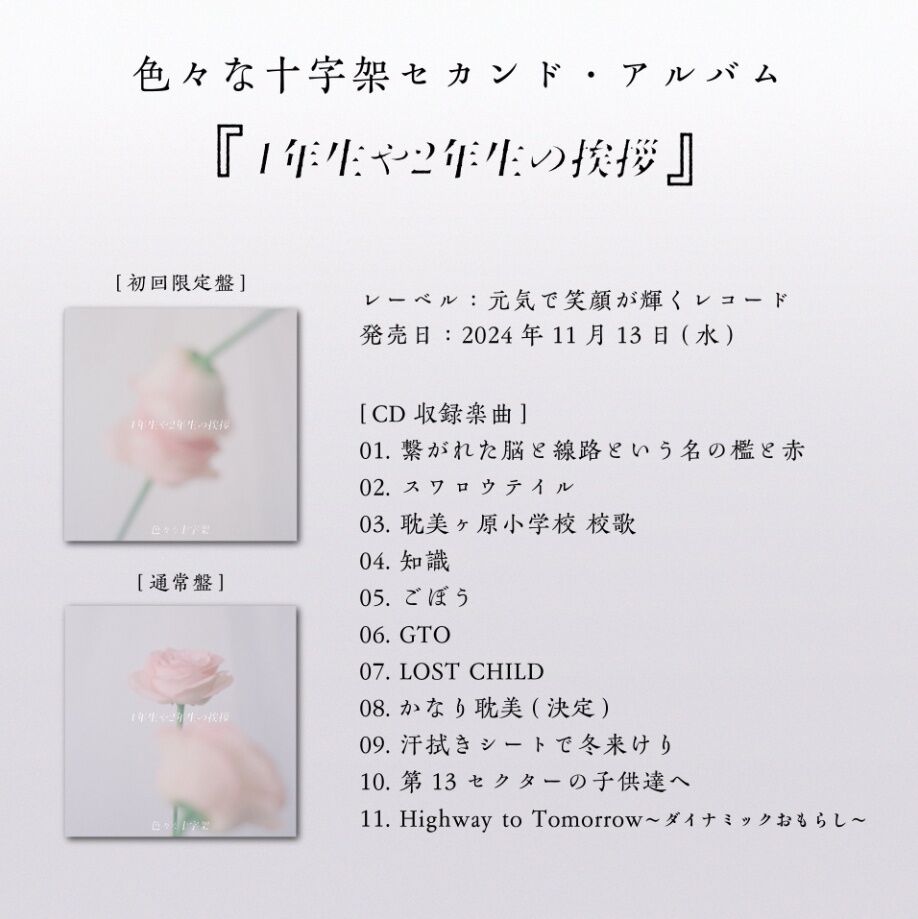
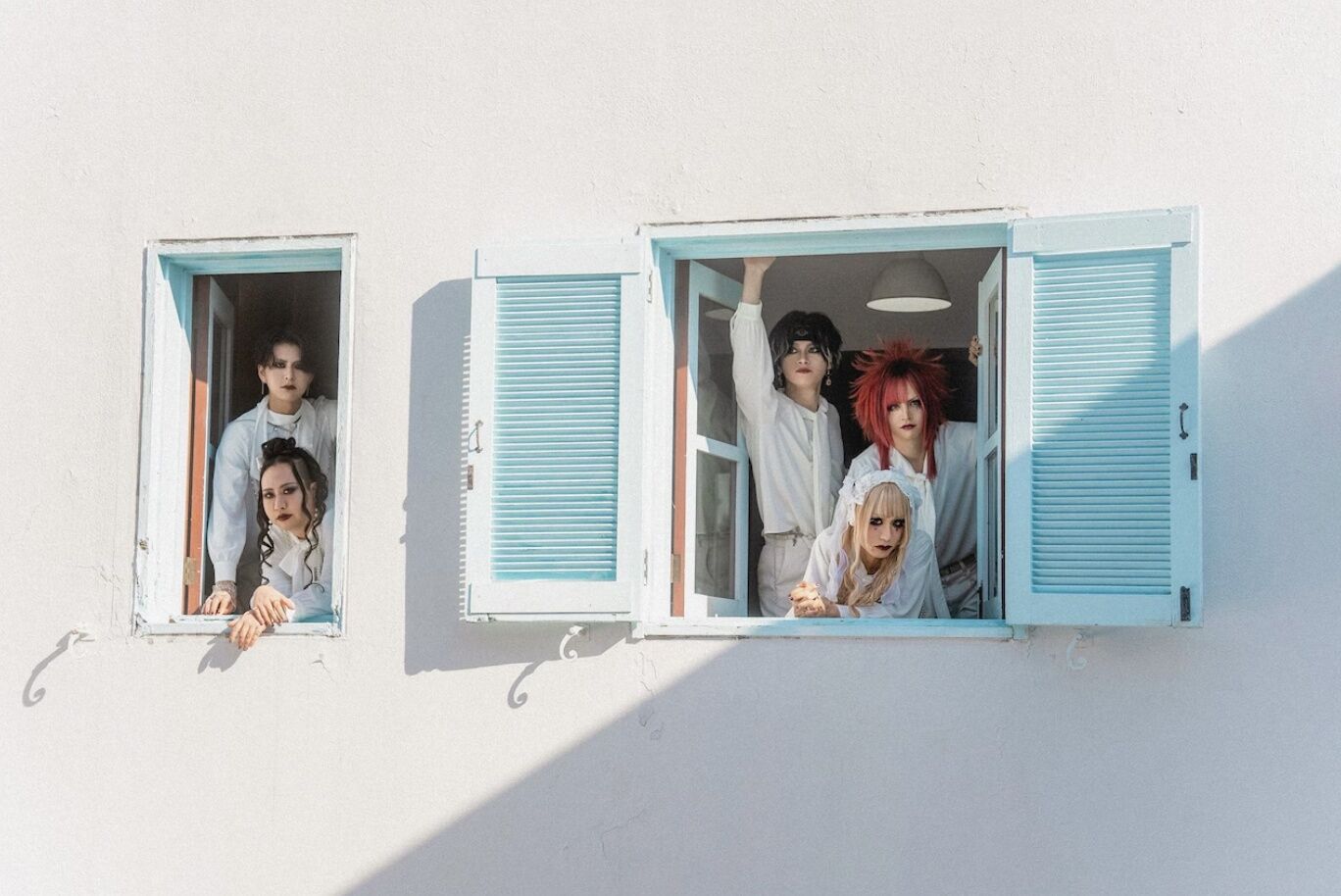
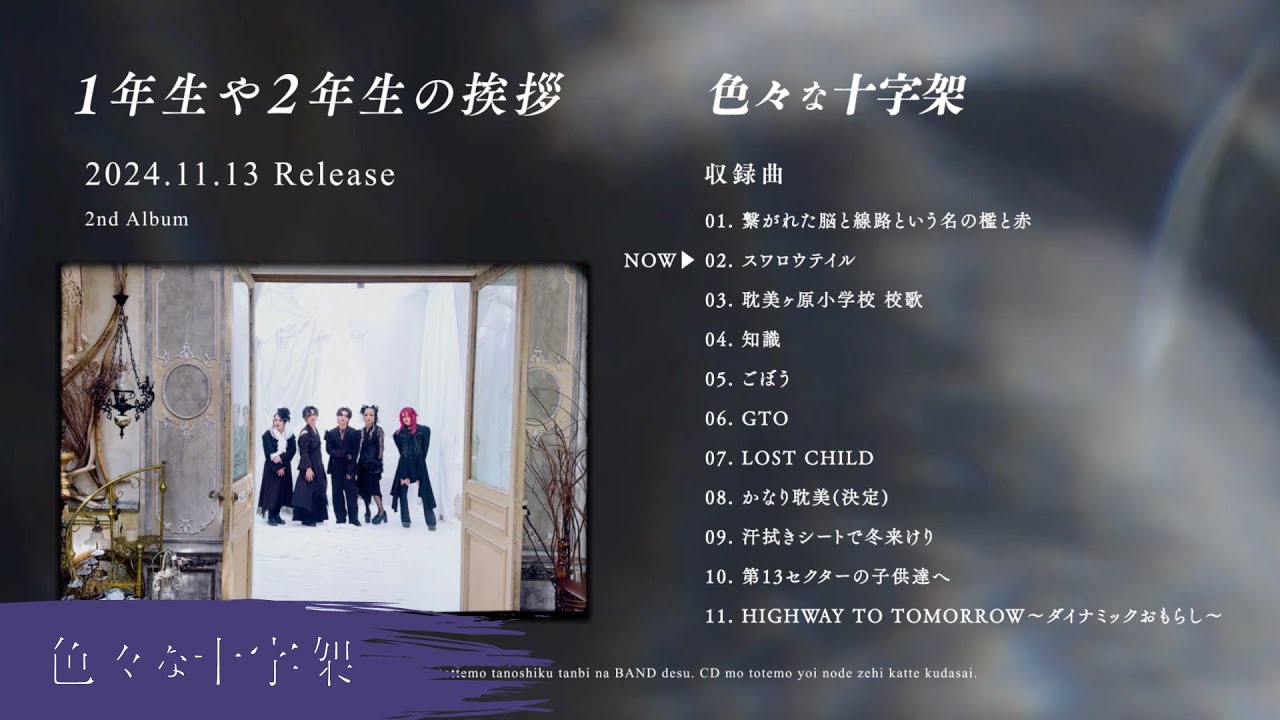
Saviors of visual kei 色々な十字架 (DIVERS † CROIX) will release their new album “1年生や2年生の挨拶” (1-nensei ya 2-nensei no aisatsu) on 2024/11/13. It will be released in two versions: regular edition and first-press limited edition that comes with a special sleeve case, 24-page photo booklet and a collectible “member visual card.”
and the packed audience was doing the “Tamakin” pose (pushing their fists together and raising them up to imitate the shape of balls), which was pretty crazy.
i save articles sometimes. here are excerpts from a relevant interview (by 藤谷千明?) (gtranslate to english, cleaned up, also if u see something way off u can let me know, idk music terms etc.)
Those who speak about the album influences †
繋がれた脳と線路という名の檻と赤
The first song is “Chained Brains, a Cage Called Railroad Tracks, and Red.” At first glance, the lyrics seem to be written in a visual kei style, but from the “railroad tracks” and “red” in the title, and the “human-faced Shupopo” in the lyrics, it’s clear that the song is about Thomas the Tank Engine.
dagaki “I love that joke. The long title is a bit like the Visual Kei tradition, and it feels full of meaning.” tink: “The original reference is Fiore.” tacato. “Among them, ‘Kimi ga Nozomu Eien and Boku wa Watashita Hitotsu Happiness’ are the references.”
Fiore was an indie band active in the mid-2000s. Were you a fan of their music?
tink: Last year, when we did a two-man show with umbrella, their bassist Haru told me about Fiore, and I thought they were really cool. I like that kind of fast neo-visual kei music, and I wanted to make music like Fiore or early GazettE.
It’s packed with a lot of different elements. The intro has the rhythm of cali≠gari’s “Anchu Roman,” and as we were arranging the B-melody, we started to add some of the Ayabie-esque elements from when Ryohei was there."
–The guitar solo that follows the dialogue in the interlude is so cool, it’s like a typical visual kei song!
tacato. “I like that kind of thing. Like Vidoll’s “Mermaid,” where different (musical) phrases blend together to form one phrase. I did something similar in my previous work (such as “Honey” from “A Little Bigger Voice”), so this is an extension of that.”
kikato “There’s a lot of syncopation in there too.” tink: “I wanted to try something with the bass slap coming to the forefront, like ‘Voy! Voy!’”
–The spoken lines are a visual kei-esque monologue, but if you listen closely you’ll hear him calling out “Hey Harold,” so there’s a consistency to the worldview. –Harold is a helicopter, so he said, “I wish I could fly like you.”
tink : “But even Harold can’t fly if he runs out of fuel, so it’s not really freedom. In the end, it’s a dystopia.” tink : “I love the ‘TRUMP’ series, and when I wrote this song I had just seen the new play (‘Marionette Hotel’), so maybe that’s why the lines turned out that way.”
–The feeling of being trapped in a box that continues forever may have something in common with the “TRUMP” series…
–The flow from the intro to the start of the second song, “Swallowtail,” has a visual kei feel to it, as well as a youthful feel.
tink: “I put a lot of effort into the lyrics of this song. The better the “serious part” is, the more the humor that comes afterwards comes to life. I think that contrast is important.”
–The line, “The petals that mistakenly do not scatter, even the mere wind speaks to them,” brings to mind a scene.
The sudden appearance of the words “first interview” after that is a huge contrast.
tink: “The ‘non-scattering petals’ are people who don’t get hired during their job hunt. The petals that don’t fall and are still there are just like us who haven’t received any job offers… Incidentally, this song is connected to an older song, ‘The Society Where Flower Language is Born’.”
tacato. “The intro to this song is inspired by the strumming guitar in Kuroyume’s “Shounen.” Overall, it also gives off a Kagerou impression.”
tink: “I had an image of a sunset, and wanted to make it sound like Kagerou. So, I left the guitar part to tacato, who also likes Kagerou…”
tacato. “I struggled with this one, too. I struggled with everything. After much trial and error, I think it ended up sounding like cali≠gari.”
–And the “Tanbigahara Elementary School Song” was composed by Kikato.
kikato: “I started making this song because I wanted more wild songs (literally songs that are easy to get wild with at live shows). But I wanted to create something akin to MALICE MIZER when Klaha was in the band or D, but with an even more tanbi feel. It’s got a really melodic feel but the chorus is just shouting.”
kikato: “I thought it would sound like a standard wild song, but the drum tech, Yamamoto (Akinori), said, ‘Wouldn’t it be fun if we made it sound like LUNA SEA’s ‘IMAGE’ or ‘EDEN’?’”
–It’s a dry sound.
kikato : “That’s right, he adjusted it in that way, and it really breathed life into the song.”
–Next is “Chishiki,” which was released as a pre-release single. It was composed by tink.
tink : “I wanted to make a song like La’cryma Christi’s ‘Forest,’ so I made a demo and hurled it at kikato-sama, who loves lacrima.” tink : “I don’t know the chords I was playing, but I sent screenshots of the video like, ‘Please read my fingers.’”
kikato : “Surprisingly, it was a proper chord. I added the ninth note to make it sound like lacrima. The ninth note isn’t something you’d normally use in American pop music, it’s considered a dissonant note, but it’s a note that’s been added recently, and I think the floating feeling is what makes it sound like lacrima.”
tink: “The song could have worked without the bass moving that much, but of course misuji created a bass line that was beyond my imagination.”
misuji : “When it comes to bass, you only need to play the root note, but I felt like if I did that, it would just be the same as other bands. I wanted to add a “hidden flavor” to the band, but it seems like that flavor has become impossible to hide.”
tink : “Thanks to that, it created a sense of speed and turned up the expression.”
dagaki: “During pre-production, I remember you saying, ‘This is how I think SHUSE would play it’ (laughs).”
misuji: When I listened to “Forest,” I got the impression that the bass player was doing something unique. He’s really going wild in the music video for “IN FOREST,” (the re-arrangement of “Forest”) (laughs).
dagaki: “Speaking of SHUSE!”
misuji “Whether or not I got close to it, I was conscious of it.”
dagaki: “The way it matched the drum kick so closely feels very SHUSE-esque. And the drumming wasn’t that similar to LEVIN’s either. It was purely to match the song. I was also careful not to lean too much towards metal.”
tink : “That’s right, the outro is different from the live version, it fades out.”
dagaki: “There were so many in the 90s.”
tink: “That’s what I was aiming for!”
ごぼう
――“Gobo” was composed by tacato. This song has a strong early 90s vibe.
tacato. “This song is reminiscent of the early days of visual kei, when that term hadn’t yet caught on. I really wanted to do a DIE IN CRIES kind of thing. There are elements of CRAZE and D-SHADE, and although the era and musicianship are different, the strong B-melody and the progression into the chorus is influenced by SEX-ANDROID. (Sekuan) have really great melodies from which a surprising hook comes out. I wanted to do something like that. So I kind of put together the things I like about my favorite bands.”
tink: “Thanks to this song, the album has become more diverse.”
tacato. “Simple rock ‘n’ roll with the feeling of raising your fist during the chorus hasn’t actually been a thing in any of our previous songs, so I thought it might be good to have a song like that. I also wanted the audience to say some strange words. I want everyone to shout out the strange words that Hatsuno (tink) came up with.”
tink: “The protagonist in the lyrics is an office worker, but he has the sensibilities of a high school student. I tried to express that kind of youthfulness.”
GTO
――“GTO” was composed by Kikato.
kikato : “I was asked by tink to make a song that was inspired by MALICE MIZER.”
tink: "For our third one-man concert, I wanted to do another musical-style song. With “Kikai Jikake no Hentai ~Racket Queen~” I followed the theme of “Tenimyu” (musicals “The Prince of Tennis” and “The New Prince of Tennis”).
――“Mechanical Pervert - Queen of Rackets” is a song that combines dialogue in a “Tenimyu”-esque 2.5D stage style with a MALICE MIZER-esque sound, and for some reason the performance at the live show also featured the use of badminton rackets, which was a highlight.
tink : “So the next one has to be ‘Haikyu!!’ or ‘Pedastage (Yowamushi Pedal)’! KOUGU Ishin has already done ‘Touken Ranbu’. When we were talking about that in the dressing room, the makeup artist said, ‘Do Saddle.’”
It would be boring to just change the parts of a bicycle, so when I started thinking about how to express the saddle, I remembered that Otoko Precure A (a local friend) had done a unicycle performance at a farewell party for sixth graders in elementary school, so I decided to use a unicycle, where the saddle is the main body, as the subject.”
– “Pedaste” is characterized by the way the cast members represent bicycle racing by holding handlebars. Meanwhile, “GTO” represents the saddle. This shows that even the makeup artist understands the iroiro na juujika worldview.
kikato : “In terms of sound, we’re not just talking about visual kei, but also 2.5D, and we’re also conscious of social games and rhythm games.”
–You mean for example, “Ensemble Stars!”
kikato : “That’s right. Those kinds of dark, gothic songs that are reminiscent of the visual kei genre of games… ALI PROJECT wrote songs for Valkyrie, a unit in Ensemble Stars!. We did take inspiration from that sort of thing. Visual kei in the 90s was pop, wasn’t it? It had a wide appeal. That’s why (if we’re promoting a 90s visual kei revival) I think it’s important to incorporate elements of songs that are popular now.”
–The dialogue was delivered by kikato and tacato.
kikato: “We recorded side by side. Just like a voiceover for anime. Recording it that way helps to capture the atmosphere.”
tacato. “The groove of the lines”
misuji: “It’s like recording the bass and drums together. It wasn’t a rhythm section, but a dialogue section (laughs).”
–And the lead track, “LOST CHILD,” has a music video. It was composed by dagaki. What are your criteria for selecting lead tracks?
tink: “How good it is!”
dagaki: “Thank you.”
– In an interview with Real Sound, you said that some of the iroiro na juujika songs were songs that the members had been sitting on and some were newly written. Which one is this song?
dagaki : “The original idea was a song I wrote when I was in a band playing guitar and vocals, and I reworked it for iroiro na juujika.
I’m the type of person who creates detailed demos, but with this song… I had already created something incredibly detailed, and when I handed it over to the other members, they reproduced it exactly as it was.”
tink: “It’s the best as it is, it’s very complete.”
(Members nod)
kikato: “It was simply great”
dagaki : “The guitars are intertwined throughout the whole song, and we play arpeggios one after the other… I even put a lot of effort into the B-melody, so I’m really grateful that the band accepted my ego.”
–It starts with a grand intro, then suddenly the first-person perspective becomes strange.
dagaki: “It’s like being suddenly brought back to reality. Actually, there aren’t many people who use the first-person pronoun “boki” in real life either. The ending “nyo” is something only anime fans from the 2000s would use.”
tink : “I wonder if this song has the same protagonist as the song “スイミーはそういうことではないです” from the previous album.” tink : “As I was writing, it occurred to me that ‘this guy’s ending sounds like nyo,’ or ‘nosu,’ and then I realized later that ‘he must be the protagonist of an existing song.’”
kikato : “Thanks to that, I can see that he’s not only knowledgeable about screws, but also about anime, and his personality really comes to light.”
tink : “I worked hard on putting the lyrics together. Especially the part in the bridge that says, ‘Mom and Dad aren’t here anymore, but they’re probably at the materials yakata next door.’”
dagaki: “Not a materials center, but a yakata.”
tink: “It was a great idea, if I may say so myself.”
dagaki: “It really captures the Cainz vibe AND the visual kei vibe.”
tacato. “Papa and Mama are also standard in lyrics in visual kei.”
tink: “We’re not forcing them out, they’re there. Bring the family.”
–The climax of the chorus is also amazing.
tink : “(singing) nejiーno maーniaー desuー. Apparently, dagaki was imagining it to be sung in falsetto at first.”
dagaki: “I was imagining a sense of transience.”
tink: “I also like DIR EN GREY, so I used Kyo’s sobbing-singing style as inspiration.”
–And so, in the end, it’s dramatic.
dagaki: “Even though the lyrics are like that, it still makes me cry a little.”
–Next up is “Kanari Tanbi (decided),” which is also your band’s account name that has been there since the beginning.
tink : "During our first oneman, I was writing a song but struggling with the motif of the lyrics. I had it up on my account, so I thought I’d just use it there, without much thought… At the time, I didn’t think I’d be so active.
The references to this song are so obvious. First of all, it’s DIR EN GREY’s “Schwein no isu,” and the riff is the same as the intro to NCT127’s “Hero; Kick It.” I put it in with a playful spirit, like, “Will anyone notice?”
--When the reference is clear, how do you go about arranging it?
**kikato: “It just kind of happened without me even realizing it…”
tacato. “It’s a song that grew out of live performances.”
汗拭きシートで冬来けり
–This song, “Winter Comes with Sweat Wipes,” starts with trap and could be called a new frontier.
tink: “Visual kei bands in this generation naturally incorporate rap and trap into their music, and if you look back at the history of visual kei, there are many great songs that are a mix of visual kei and rap. I like that mix too, but I wanted to try a different approach. That’s why the title of the demo is ‘No Mixture’!” tink: “The first half of the song incorporates elements of K-Pop, particularly (G)I-DLE’s “MY BAG,” and the sound incorporates elements of Saweetie’s “Best Friend (feat. Doja Cat),” which “MY BAG” likely references. I’m excited to see if listeners can get that far.
The song in the second half was inspired by Chanmina’s “Bijin”. I was watching “PRODUCE 101 JAPAN THE GIRLS” and heard the assigned song “Bijin” and thought it was nice. Also in the second half was some DIR EN GREY… It’s a mix of different things like that."
–Will you be performing it live?
tink: “We haven’t done it yet.”
dagaki: “It’s a song we made for the album.”
tacato. “I think these kinds of experimental songs are visual kei if anything. DIE IN CRIES’ first album (‘NOTHINGNESS TO REVOLUTION’, released in 1991) is so experimental and confusing, I love it.”
kikato: “BUCK-TICK’s ‘Kamikaze’ too.”
tacato. “It has a BUCK-TICK vibe to it, like ‘darker than darkness -style 93-’”
tink : “We were talking about wanting to incorporate an industrial, or rather, a BUCK-TICK-esque sound from that time.”
–Can I ask you about the lyrics?
tink: “If you wipe your balls with a sweat wipe, you too can fly in the sky. This is a song for fans of that.”
tacato. “In short, for a damn M.”
tink: “Probably the guy in “Kanari Tanbi (kettei)”. He rides his bike naked, so I feel like there’s a connection.”
第13セクターの子供達へ
–Next song: “To the Children of Sector 13.”
tink: “The space-like VJ was done first, so the lyrics came from that. As for the song, I wanted to take advantage of the fact that misuji has no experience with visual kei, and do something with dub, reggae, Fishmans, or Yura Yura Teikoku, but in a visual kei style…
So (looking at tacato.) I left it all to him.”
tacato. “I struggled a lot with this song too. The chord progression in the chorus is very Yura Tei-esque, but I also realized that it’s the same chords as in visual kei. It’s a song that brought an interesting discovery.” tacato. “Then it became like shoegaze.”
tink : “Also, I thought that if I used Fishmans and Yura Yura Teikoku as references, misuji would get excited.”
misuji: “I’ve always loved Fishmans and listened to them all the time. I don’t come from a visual kei background, so when visual kei is the reference, it’s fun to discover new songs, but in this case, it was like, ‘I get it! I know this!’ It was a natural influence, and the atmosphere may have come out. But I wasn’t copying them, so it was difficult in some ways.”
tink: “The bass really brings out the dub and reggae vibes I originally wanted to achieve.”
Kikato: “For the flashy reverberation of the drums, like ‘stomp! boom!’, I used gated reverb, which was popular in the 80s, because it’s visual kei. With Fishmans or regular dub, you’d use retro analog delays and reverbs.”
dagaki: “I think Being used gated reverb a lot in the 90s.”
kikato : “ROUAGE used it a lot too. It gives it a dub-like feel, so I think it’s interesting.”
dagaki: “It has a mysterious vibe, like a cross between dub and visual kei.”
kikato: “It would’ve been boring to end with that, so we included solo parts for everyone. And that’s why it’s so hard to memorize…”
tink: “Simply put, I think I was able to write great lyrics. With this song, I didn’t “write” the lyrics, I “painted” them.”
–That might be quite L’Arc-en-Ciel-like in a way.
tink: “I think I was conscious of the ‘___ no you ni’ parts. Like ‘like a wound healing’ or ‘like the sky clearing up.’ It’s not the exact words Hyde uses, but it does remind me of him.”
end
–And since releasing “A Little Louder Voice,” it feels like the scope of your activities has expanded. I think that’s reflected in the title, “Greetings from First and Second Year Students.” What’s more, your Kinema Club solo concert this month is sold out, so you could call it a great success. How do you personally feel about this?
kikato : “I’ve always wondered, ‘Why?’ Of course, I’m aware that we have cool songs and are a cool band, but honestly, I still don’t understand why we’ve received so much recognition. We haven’t done any major promotions or advertising… I’m just constantly amazed at how the number of people interested in us just keeps increasing. It’s a mystery to me.”
dagaki : “We have a visual kei style, but the lyrics are silly, so we were worried that some people wouldn’t like it, or that in fact only a few people would accept it, but we got a better response than we expected, and seniors kept reaching out to us. We’re all really serious about music, so I think that genuinely got across.”
tink: “Up until now, if I did something a little bit eccentric, it was often met with a cynical response like, ‘Not again!’ But when I release visual kei work, people say if they like it, they like it, and if they don’t, they don’t, and I’m happy that they appreciate it honestly. It’s a very generous and kind world.”
misuji: “Even though I’m not a visual kei fan, I know the names of band members, like Tsubame from BugLug and Hiyori Isshiki from Kiryu. I found myself going out drinking with them and they started treating me like an equal…”
tacato. “I like visual kei, and I was in a visual kei band in the past. Visual kei takes a lot of effort, and there are a lot of different things going on (compared to other genres). You can’t do that unless you love it, right? When seniors in that scene and people of my generation take us seriously, I feel like they understand that we love it, and that our music allows us to connect with people who were previously like a godsend to us. It makes me really happy.”
– Listening to you talk, I can sense the joy and happiness you all have. It’s amateurish in a good way, and you’re doing high-quality work while still maintaining a school festival-like feel. I hope you continue to have fun like this.
tink : “There are still so many songs I want to do and haven’t done yet.”

 it’s just doing its best to transcribe whatever audio it can catc h still